Bodies of Work: Paintings and drawings by Jerome Hershey, 2022–2026
© 2026 Linda S. Aleci, PhD, Associate Professor Emerita of Art History, Franklin and Marshall College
The paintings and drawings featured in this book and in the show Rhythms and Reactions are, in many ways, a summa of Jerome Hershey’s work. Made between 2022 and 2026, they reflect a decades-long commitment to a mode of abstraction anchored in color relationships, painting as an exacting process of mark-making and a deep respect for materiality and the physical world. Alluding to their dynamic formal qualities and engagement with events of the last four years, the exhibition suggests the ways that Hershey’s art moves in a kind of dialogue with its time and place. But it is the historic nature of these unsettled times that raises a more pointed issue: Why does this art matter in a time of personal, social and political upheaval? That is, how does one situate this particular body of work in the circumstances that give rise to it?
Observers of Hershey’s paintings have at times struggled to reconcile the works’ seemingly contradictory elements: the rigorous formalism found in strains of post-war Abstraction with the perceived localism of their references and handcraft sensibility; and the intimacy of their subject matter with the ostensible detachment of geometric structure and pattern. Some see the work in purely perceptual terms, to be experienced without analysis as one writer suggests, paintings that condense Hershey’s “entire lived experience” in the “infinitely complex, colors and patterns occurring naturally in Lancaster County fields.”¹ For others the visual language is more concrete, “a complex mixture of sophisticated decoration and a deep need to fix communicative and narrative values” reflecting the heritage of Amish bar quilts.²
Hershey is alert to these tensions, describing his work as non-referential, and painting as an extended process of shaping ideas and life-events. Animated by experiences of sickness, grief, hope and persistence, they are deeply affecting: Meditations on the loss of his parents (Rose Variations, 2002–2003; Tribute, 2005–2009); the expressive deconstruction of language and its rebirth into visual form (Words, 2009–2018; Playing? (around), 2015–2018); “marking time” during the COVID pandemic and the 2020 election (Fields, 2017–2021).
To understand them only as a kind of life-writing rendered in the language of abstraction nonetheless misses an important dimension of their material force. Read through the structure of the grid, Hershey’s paintings unexpectedly yield living surfaces, tremulous with hand-painted filaments of color. At once disciplined in composition and luxuriant from the swelling and contraction of the brushstroke, each painting bears the record of patient labor. Unfolding in monumental series, their totality constitutes a formidable body of work—the artist’s corpus, a powerful metaphor that elides paintings and maker as a felt reality. So embodied, the paintings are active sites of memory, history and experiences, works of intense opticality and physical vibrance carrying traces of past events and materializing forces shaping the present.
As chronological groupings, the paintings and drawings included in Rhythms and Reactions nominally constitute two distinct series; as bodies of work, they are integrally linked. Conceived in the wake of Hershey’s recovery from open heart surgery, the series Breath (2022–2024) makes corporeality explicit, the body experienced through acts of inhaling and exhaling. Spin, begun in 2025, extends and complicates our sense of the body as an autonomous entity to become an expression of polity—the body politic that finds itself under siege. As the artist’s corpus, the paintings and drawings challenge aesthetic complacence inviting us to engage through the body as part of the processes of living in these times. They are, importantly, works that prompt a reflection on our material existence as it intertwines with illness, political power and resistance, the corporeality that binds us to their maker, and to each other.
Breath: The Body of the Artist
Although Hershey did not begin the Breath paintings until 2022, the years of quarantine during COVID-19 arguably contribute to their coherence as a series, shaping their content, visual language and defining their conceptual interdependence with Fields and Spin. In retrospect, the pandemic was a kind of interregnum, a liminal state of existence between the presidential administrations of 2016 and 2024 and, ultimately, of enormous political consequence.³ Indelibly marked by a blundering response to the spread of the virus, massive unemployment and civil unrest, the pandemic magnified a social order of deep racial injustice and partisan division.⁴ Through the imaginaries of contagion, its political and racial trajectories sharpened long-held cultural associations made between the human body, the political body and disease.
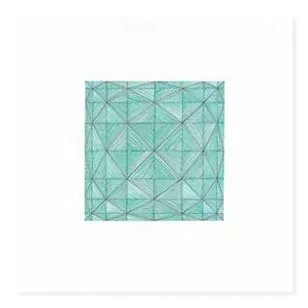
2202 (breathe), 2022, ink on gessoed board, 10" x 10". Collection of the artist.